Assam — officially the Land of the Red River and Blue Hills — is India's most dramatically underrated travel destination. While millions flock to Rajasthan and Goa every year, those who discover Assam encounter something extraordinary: a state where a one-horned rhinoceros crosses the highway at dawn, where the world's mightiest river island is home to centuries-old monasteries, and where a single cup of tea grown in a colonial bungalow garden changes the way you think about breakfast forever. Assam tour packages from Tour Venture India are designed to immerse you in every layer of this extraordinary state — wildlife, pilgrimage, culture, cuisine and the slow, unhurried magic of the Brahmaputra river.
Assam covers 78,438 sq km in the northeast corner of India, bordered by Bhutan and Arunachal Pradesh to the north, Nagaland and Manipur to the east, Meghalaya, Tripura and Mizoram to the south, and West Bengal to the west. The mighty Brahmaputra river — one of Asia's great rivers and one of very few rivers in the world to have a male name — flows 900 km through the heart of the state, creating a vast floodplain that is both the source of Assam's extraordinary biodiversity and the greatest challenge for its people every monsoon season.
Unlike most other Northeast Indian states, Assam requires no Inner Line Permit (ILP) for Indian nationals and has straightforward visa access for most foreign tourists. With daily direct flights from Delhi (2 hours), Mumbai (3 hours) and Kolkata (50 minutes) to Guwahati's Lokpriya Gopinath Bordoloi International Airport, Assam is the most accessible of all northeastern states — and for Tour Venture India, the starting point of some of our finest itineraries in the region.
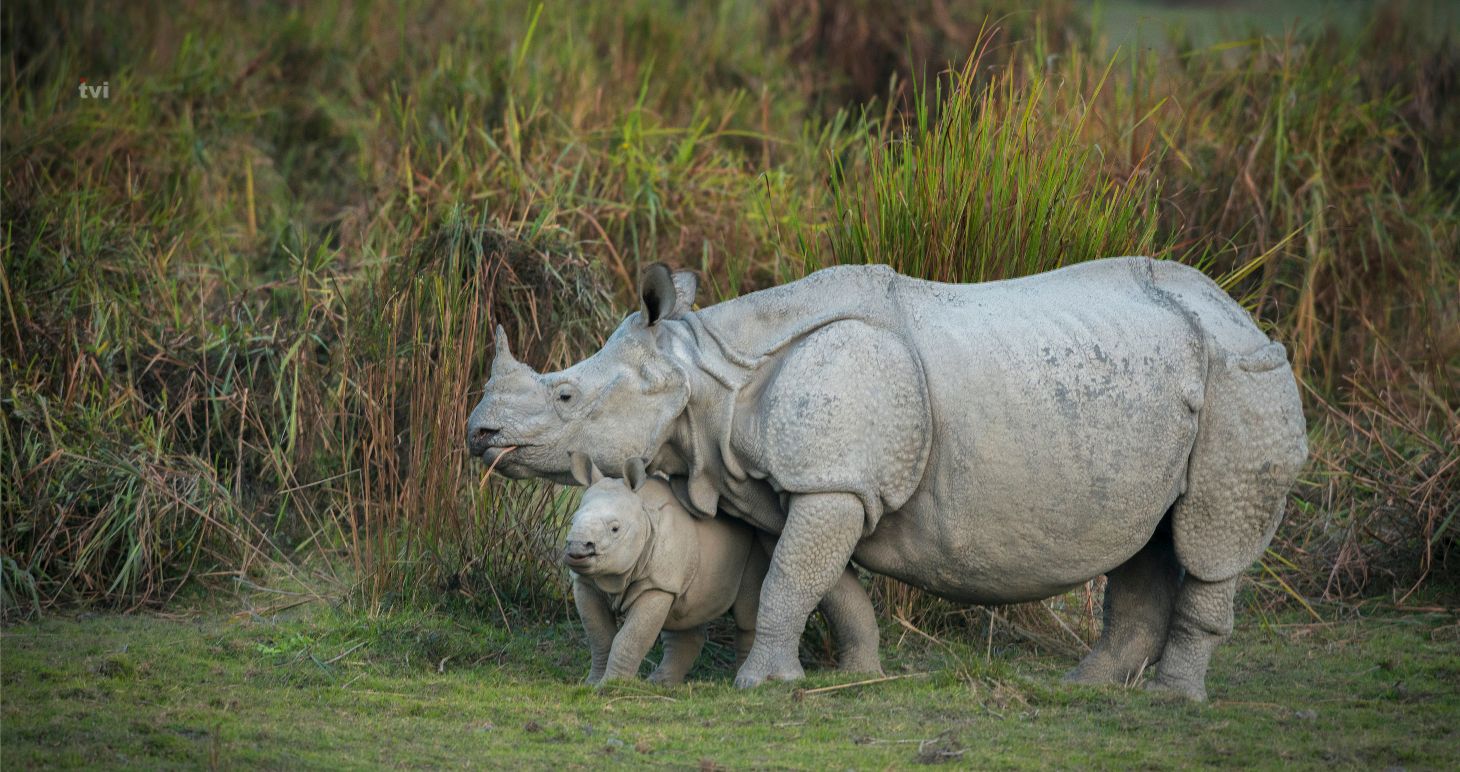
Kaziranga National Park is without question one of the greatest wildlife spectacles on Earth. A UNESCO World Heritage Site since 1985, Kaziranga spans 430 sq km of tall elephant grass, dense tropical forests, and wetlands along the south bank of the Brahmaputra. It is home to the world's largest population of the Indian One-Horned Rhinoceros (Rhinoceros unicornis) — over 2,613 rhinos as of the 2022 census, representing roughly 70% of the entire global population of the species.
What makes Kaziranga uniquely compelling for wildlife travellers is the density and certainty of sightings. On a single morning jeep safari through the Central Range, it is entirely normal to encounter 15 to 30 rhinos in the wild — grazing, wading through swamps, or simply standing placidly by the road at remarkably close range. Kaziranga also has the highest density of Royal Bengal Tigers of any protected area in India — higher even than Ranthambore or Bandhavgarh — with approximately 121 tigers recorded in the 2022 count. Yet tiger sightings here remain rare precisely because the grasslands are so tall and dense.
Beyond the headline species, Kaziranga hosts over 35 mammal species including Asian Elephant (over 1,100 individuals), Wild Water Buffalo, Swamp Deer (Barasingha), Sloth Bear, Hoolock Gibbon and the rare Gangetic River Dolphin in the Brahmaputra waters that border the park. The park's 517 bird species make it a major destination for birdwatchers — including the Greater Adjutant Stork (critically endangered), Spot-billed Pelican, Bengal Florican and the migratory Bar-headed Goose that winters here from Central Asia. Kaziranga is divided into five ranges (Western/Bagori, Central/Kohora, Eastern/Agaratoli, Burapahar and Ghorakati) each offering different terrain, vegetation and wildlife opportunities. Tour Venture India pre-books the limited morning jeep safari slots in the Central and Western ranges, which offer the highest rhino density and best photography conditions.
Elephant Safari vs Jeep Safari — Which to Choose?
Elephant Safari (5:30–7:30 AM): Conducted on the back of trained elephants, these go deep into the tall grass where jeeps cannot venture. You'll often get within 10 metres of rhinos. Limited to 4 seats per elephant. Must be pre-booked weeks in advance — Tour Venture India handles all advance bookings. Jeep Safari (5:30–9:00 AM and 2:00–5:00 PM): Covers more ground across designated tracks. Better for photography and bird watching. Both safaris are permitted only in designated zones and must be accompanied by a licensed forest guide. Our recommended combination is an early elephant safari followed by a morning jeep safari for the most complete Kaziranga wildlife experience.
Majuli Island — The World's Largest River Island
Majuli sits 20 km northeast of Jorhat, accessible by ferry across the Brahmaputra. It holds the Guinness World Record as the world's largest inhabited river island at 880 sq km — though river erosion has been steadily reducing its size from 1,250 sq km a century ago, a sobering reminder of the Brahmaputra's awesome, destructive power. Majuli was given district status in 2016, making it the world's first river island to become an administrative district.
Majuli's most extraordinary cultural legacy is its Vaishnava Satras — monastic institutions established between the 15th and 17th centuries by the Vaishnavite saint-reformer Srimanta Sankardeva. These Satras are simultaneously monasteries, community centres, performance stages and living museums of Assamese artistic tradition. The monks — called bhokots — maintain daily schedules of prayer, classical dance (Sattriya, now a recognised classical dance form of India), mask-making, manuscript writing and weaving. Twenty-two Satras survive on Majuli today, each with a distinct lineage, deity and artistic speciality.
The Auniati Satra (founded 1653) is the largest and holds a remarkable collection of antique artefacts — jewellery, utensils and weapons once belonging to Ahom kings. The Kamalabari Satra is the most welcoming to visitors and allows guests to witness the morning prayer ceremony (naam-kirtan). Dakhinpat Satra is famed for its Raas Mahotsav celebrations in November, when thousands of devotees come to witness the Vaishnavite festival. Visiting Majuli during Raas Mahotsav (October–November full moon) is one of the most culturally immersive experiences available in northeast India — Tour Venture India builds special Majuli Raas Festival itineraries each year.
Beyond the Satras, Majuli is home to the Mishing tribe — one of Assam's largest plains tribes — who live in traditional stilt houses (chang ghar) built above the flood level of the Brahmaputra. The Mishing are known for their handwoven textiles featuring distinctive geometric patterns, their fermented rice beer (apong), and their intimate knowledge of the river ecosystem. A morning cycle ride through Mishing villages, past bamboo groves and paddy fields with the Himalayan foothills visible in the distance on clear winter days, is among the most peaceful travel experiences in all of India.
Kamakhya Temple — Assam's Most Sacred Pilgrimage Site
Kamakhya Temple on Nilachal Hill in Guwahati is one of India's 51 Shakti Peethas and one of the most important Tantric temples in the subcontinent. According to Hindu mythology, when Lord Shiva carried the body of his wife Sati in grief, Lord Vishnu used his Sudarshana Chakra to dismember her body to release Shiva from his anguish. The 51 places where her body parts fell became Shakti Peethas — sites of immense spiritual power. Kamakhya is the spot where her yoni (womb) fell, making it the most significant of all Shakti Peethas for Tantric practitioners.
The current temple structure was built in 1565 CE by the Ahom king Naranarayana after the original temple was destroyed in the 13th century. The distinctive beehive-shaped (shikhara) tower is unique in Indian temple architecture and has become the visual symbol of Guwahati. The sanctum sanctorum houses no idol — instead, a natural rock cleft (yoni-shaped) that is always moist with underground spring water is the object of worship. The temple complex also houses shrines to the ten Mahavidyas — the ten manifestations of the Goddess — making it a comprehensive pilgrimage site for Shakta devotees.
The annual Ambubachi Mela (June) is when the temple is closed for three days — believed to be when the Goddess menstruates and the Earth is especially fertile. When the temple reopens, hundreds of thousands of pilgrims gather for what is considered the most powerful Tantric festival in India. Tour Venture India offers special Ambubachi Mela packages for devotees who wish to attend this extraordinary event — accommodation must be booked at least 3 months in advance due to the enormous crowds.
Assam Tea Gardens — Where Every Cup Has a Story
Assam is the world's largest single tea-growing region, producing approximately 700 million kg of tea annually — about 55% of India's total tea production and 17% of global supply. The tea industry was established by the British in the 1840s after Scottish botanist Robert Fortune confirmed that the wild tea plants growing in the Brahmaputra valley were the same species (Camellia sinensis var. assamica) as those cultivated in China. By 1900, there were over 700 tea estates in Assam; today there are approximately 800 large gardens and thousands of small tea growers.
The Assam tea belt extends primarily through Jorhat, Dibrugarh, Tinsukia and Sivasagar districts. The most celebrated estates include Halmari Tea Estate (Morigaon), Makaibari Estate, and the colonial bungalow estates around Jorhat that have been converted into heritage stay properties. Assam produces predominantly strong, full-bodied CTC (Crush, Tear, Curl) tea — the black tea that gives your morning brew its characteristic deep colour and malty flavour — as well as premium Orthodox and Green teas now gaining popularity in specialty markets.
A tea garden tour arranged by Tour Venture India typically includes: an early morning walk through the plucking fields with a naturalist guide, a visit to the tea factory to witness withering, rolling, oxidation and drying stages, a professional tea-tasting session (cupping) with the estate's tea taster, and lunch at the colonial planter's bungalow. Staying overnight at a heritage tea bungalow — surrounded by the intoxicating smell of fresh tea leaves at dawn — is an experience that no luxury hotel in a city can replicate.
Brahmaputra River — The Soul of Assam
The Brahmaputra is not merely a river — it is the defining force of Assam's geography, history, culture and daily life. Rising from the Angsi Glacier in Tibet as the Yarlung Tsangpo, it flows east through China for 1,700 km before making one of the sharpest turns in any river's geography — nearly 180 degrees — around the Namcha Barwa massif (7,782 m) to enter Arunachal Pradesh. By the time it enters Assam at Sadiya, it has descended from 4,000 metres to 150 metres in less than 200 km, creating extraordinary energy. The Brahmaputra is one of very few rivers in the world to be classified as a braided river — constantly shifting its channels, creating and destroying islands, reshaping the landscape every monsoon season.
For travellers, the Brahmaputra River Cruise is the most luxurious and atmospheric way to experience Assam. Luxury river cruise boats — including the flagship Charaidew and Sukapha vessels operated by the Assam Bengal Navigation Company — travel between Kolkata and Dibrugarh over 11–23 days, stopping at Kaziranga, Majuli, Guwahati and dozens of remote sandbank islands and village ghats along the way. Shorter 2–4 night cruises are available between Guwahati and Kaziranga. River cruise passengers regularly spot Gangetic River Dolphins — an endangered freshwater dolphin species found only in the Ganga-Brahmaputra system — as well as rare fishing cats, river otters and extraordinary sunset views over the 10-km wide river as it flows through the Assam valley.
Manas National Park — UNESCO's Comeback Story
Manas National Park is one of wildlife conservation's greatest success stories — and one of its most dramatic. Inscribed as a UNESCO World Heritage Site in 1985, Manas was placed on UNESCO's List of World Heritage in Danger in 1992 after years of poaching and armed insurgency by Bodo militant groups devastated the park's wildlife. By 2000, the rhino population had fallen from 80 to near zero, elephant numbers had collapsed, and the park infrastructure was in ruins.
The recovery since the Bodoland peace agreement of 2003 has been remarkable. Working with the Bodo Territorial Council, the Wildlife Trust of India and the Indian Rhino Vision 2020 project, Manas has been rebuilt from the ground up. Rhinos — translocated from Pobitora Wildlife Sanctuary and Kaziranga — have reestablished a breeding population. By 2023, Manas had over 55 rhinos, 40 tigers, 3,000 elephants and had been removed from UNESCO's danger list in 2011. It is now considered one of India's finest and most biodiverse national parks, spanning 950 sq km in western Assam along the Bhutan border. The pristine Manas River that flows through the park — crystal clear and fast-flowing from the Bhutanese Himalayas — is itself one of the most beautiful rivers in northeast India.
Sivasagar — Capital of the Ahom Empire
Sivasagar (formerly Rangpur) was the capital of the Ahom Kingdom — a dynasty that ruled Assam for an extraordinary 600 years (1228–1826 CE) and is one of the few kingdoms in Indian history to have successfully repelled the Mughal Empire, defeating their armies seventeen times. The Ahoms were originally from the Shan hills of present-day Myanmar and arrived in Assam in the 13th century, gradually converting from their native Tai religion to Hinduism while preserving many of their distinctive cultural practices.
The archaeological legacy of the Ahom empire in Sivasagar is remarkable. The Sivasagar Lake (Sibsagar), constructed in 1734 by Ahom queen Ambika, is the largest human-made lake in Asia at its time of construction, covering 257 acres. On its banks stand three important temples: the Sivadol (tallest Shiva temple in India at 54.8 metres), the Vishnu Dol and the Devi Dol. The Rang Ghar — built in the 18th century as a royal sports pavilion for watching elephant and buffalo fights — is the oldest surviving amphitheatre in Asia and an engineering marvel. The Kareng Ghar (royal palace), the Talatal Ghar (a seven-storey palace with three underground tunnels used for secret access during wars), and the Hayagriva Madhava Temple in nearby Hajo complete the remarkable Ahom heritage circuit.
Best Time to Visit Assam — Month-by-Month Guide
🏆 Peak Season: Oct – Feb
Best wildlife sightings at Kaziranga and Manas. Cool dry weather (15–25°C). Rhinos, elephants and tigers most active. Raas Mahotsav festival at Majuli in November. Migratory birds arrive November onwards. Ideal for photography. Book 2–3 months in advance.
🌸 Good Season: Mar – Apr
Rhododendron season. Warmer (25–35°C) but Kaziranga still open until April 30. Tea first flush harvest — best time for tea estate visits. Ambubachi Mela prep begins. Good for culture and pilgrimage tours. Bihu festival in April is Assam's biggest celebration.
⛔ Avoid: May – Sep
Kaziranga fully closed (May 1 – Oct 31). Monsoon floods the Brahmaputra valley. Roads damaged. Heavy rainfall. Manas and tea gardens remain accessible. Ambubachi Mela at Kamakhya Temple in June — very crowded but spiritually powerful. Not recommended for first-time visitors.
Assam Tour Packages — Price & Duration Comparison
| Package |
Duration |
From (per person) |
Best For |
| Kamakhya Temple & Guwahati | 2N/3D | ₹7,999 | Pilgrimage, weekend trip |
| Majuli Island Cultural Tour | 3N/4D | ₹8,999 | Culture, solo, offbeat |
| Assam Tea Garden Tour Jorhat | 3N/4D | ₹10,999 | Leisure, couples, heritage stays |
| Kaziranga National Park Safari | 3N/4D | ₹12,999 | Wildlife, families, photographers |
| Manas National Park Tour | 3N/4D | ₹13,999 | Wildlife, offbeat, tigers |
| Assam Shakti Peethas Circuit | 5N/6D | ₹14,999 | Pilgrimage, devotees |
| Kaziranga + Majuli Combo ⭐ | 5N/6D | ₹16,999 | Best overall — wildlife + culture |
| Brahmaputra River Cruise | 4N/5D | ₹22,999 | Luxury, honeymoon, river dolphins |
How to Reach Assam — Complete Transport Guide
By Air: Guwahati's Lokpriya Gopinath Bordoloi International Airport (GAU) is the primary gateway with 1,400+ weekly flights. Direct connections from Delhi (IndiGo, Air India, Vistara — ~2h), Mumbai (3h), Kolkata (50 min), Bengaluru (3h) and Chennai (3h 30min). Jorhat Airport (JRH) is closer to Kaziranga (90 km) and has limited flights from Kolkata. Dibrugarh Airport (DIB) serves the upper Assam tea belt. Tour Venture India arranges pickup from all three airports.
By Train: Guwahati is one of northeast India's major rail junctions. The Rajdhani Express from New Delhi takes 36 hours; the Poorva Express from Kolkata takes 18 hours. For Kaziranga, the nearest station is Furkating (30 km from Kohora gate) or Jorhat Town (85 km). Dibrugarh Town station serves the upper tea belt. Indian Railways' Northeast Frontier Railway zone operates special tourist trains including the Kaziranga Express.
By Road: National Highway 27 (formerly NH 37) connects Guwahati to Kaziranga (215 km, 5 hours). The road passes through Nagaon and is generally in good condition outside the monsoon months. State transport buses and private coaches operate between major towns. Tour Venture India provides dedicated private vehicles for all inter-city transfers — a more comfortable and flexible option than public transport given the distances involved.
Sample Itinerary — Assam Grand Tour (8 Nights / 9 Days)
1
Day 1 — Arrive GuwahatiAirport pickup. Check into hotel. Evening visit to Kamakhya Temple for sunset aarti. Dinner at a local restaurant featuring masor tenga (sour fish curry) and paro mangkho (duck curry). Briefing on the journey ahead.
2
Day 2 — Guwahati City & Umananda IslandMorning — Kamakhya Temple darshan, Navagraha Temple (the nine-planet observatory temple), Umananda Island by ferry, State Museum. Afternoon drive (215 km) to Kaziranga. Evening at resort.
3
Day 3 — Kaziranga Safari Day 1Pre-dawn elephant safari (5:30 AM) in Central Range — the best zone for close rhino encounters. Breakfast. Rest. Afternoon jeep safari in Western Range for different landscape and bird watching. Naturalist briefing on rhino ecology in the evening.
4
Day 4 — Kaziranga Eastern Range & JorhatMorning jeep safari in Eastern/Agaratoli Range — least crowded, best for Wild Buffalo and Swamp Deer. Drive to Jorhat. Tea estate visit — walk through plucking fields, factory tour, tea tasting. Check into heritage tea bungalow.
5
Day 5 — Majuli IslandMorning ferry to Majuli. Cycle tour through Mishing villages. Visit Kamalabari and Auniati Satras. Attend afternoon prayer ceremony. Sunset on the Brahmaputra sandbanks. Overnight at island eco-lodge.
6
Day 6 — Majuli to SivasagarMorning — Dakhinpat Satra visit, traditional mask-making workshop. Ferry back. Drive to Sivasagar. Evening — Sivadol Temple, Sivasagar Lake at sunset. Overnight Sivasagar.
7–8
Days 7–8 — Sivasagar Heritage & ReturnDay 7: Rang Ghar, Kareng Ghar, Talatal Ghar, Hayagriva Madhava Temple at Hajo. Day 8: Drive to Guwahati (395 km, 8 hrs) or fly from Jorhat. Departure transfers. Tour Venture India assists with onward bookings to Arunachal Pradesh or Meghalaya if extending your Northeast trip.
Assamese Cuisine — A Food Lover's Guide
Assamese cuisine is one of India's most distinctive and least-known regional cooking traditions — light, herb-forward, minimally spiced and built around the extraordinary freshness of its river fish, wild greens and fermented ingredients. It is worth planning meals around as deliberately as you plan safari timings.
Masor TengaSour fish curry made with tomatoes, elephant apple or lemon. The defining dish of Assamese cooking. Light and refreshing.
Paro MangkhoDuck curry — slow-cooked with ash gourd, the definitive Assamese festive dish. Available at most good local restaurants.
KharAlkaline preparation made from dried banana peel ash water — a starter dish unique to Assamese cuisine with a distinctive cleansing flavour.
PithasRice cakes in dozens of forms — steamed, fried, stuffed with jaggery or sesame. Central to Bihu celebrations and served with butter tea.
ApongMishing tribal rice beer — lightly fermented, mildly alcoholic, served in bamboo mugs in Majuli villages. A cultural experience in itself.
First Flush Assam TeaMarch–April harvest. Delicate, bright and floral — completely unlike the robust CTC tea sold commercially. Only available directly from estates.
Why Book Your Assam Tour with Tour Venture India?
Pre-booked morning elephant & jeep safari slots at Kaziranga — limited and fills up weeks in advance
Curated heritage tea bungalow stays and Majuli eco-lodges not available on booking portals
Expert naturalist guides with Kaziranga Forest Department accreditation for all safaris
No ILP required — fastest North East state to organise. We handle all entry formalities
24/7 WhatsApp support — our local team is always reachable even in remote forest areas
5,000+ tours arranged with a 4.8-star average rating — GST-registered verified operator
 3N / 4D🦏 Wildlife
 3N / 4D🐅 Wildlife
 5N / 6D🦏 Wildlife
 2N / 3D🕉️ Pilgrimage
 5N / 6D🕉️ Pilgrimage
 3N / 4D🎭 Culture
 3N / 4D🍵 Tea Garden
 4N / 5D🚢 Cruise