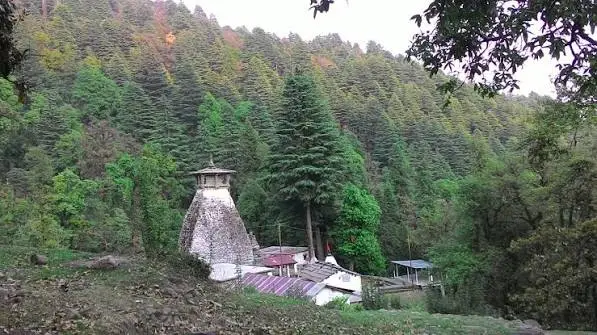
A 10th-century Nagara-style Shiva temple built by the Katyuri dynasty, set in dense oak and rhododendron forest at an altitude of 2,480 m (8,136 ft), about 48 km from Ranikhet and 45 km from Almora. The main deity is Lord Shiva (Shivalinga). Open 7 AM–12 PM & 3–7 PM daily.
By Tour Venture India Travel TeamCovers Ranikhet & Almora tours since 2015 Last updated: 6 min read
Quick Answer
Binsar Mahadev Temple is a 10th-century Shiva temple built by the Katyuri dynasty, located in dense forest at 2,480 m altitude, about 48 km from Ranikhet and 45 km from Almora. Timings: 7 AM–12 PM and 3–7 PM. Best time: October–November and March–May.
What is Binsar Mahadev Temple and Where is it Located?
Binsar Mahadev Temple is one of the most historically significant Shiva temples in the Kumaon Himalayas, located in Almora district, Uttarakhand, about 48 km from Ranikhet and 45 km from Almora. It stands at an altitude of 2,480 m (8,136 ft), deep within a continuous stretch of oak and rhododendron forest that forms part of the broader Binsar forest zone.
The temple complex enshrines Lord Shiva in the form of a Shivalinga, and the main sanctum also contains smaller shrines to Hara-Gauri and other deities. The setting — a dense, quiet forest clearing at high altitude — gives it a stillness that draws both pilgrims and nature enthusiasts. The nearest railway station is Kathgodam, roughly 100 km away, and Delhi is approximately 350 km via the Moradabad–Haldwani route.
About this guide: Tour Venture India has operated Ranikhet and Almora sightseeing tours since 2015 and has first-hand experience visiting Binsar Mahadev Temple with guests. Historical information is sourced from ASI records and local temple authorities. Road distances and travel times are approximate and may vary with season and road conditions.
Deity
Lord Shiva
Timings
7–12, 3–7 PM
Distance
48 km from Ranikhet
Altitude
2,480 m (8,136 ft)
Best Time
Oct – Nov
What is the History of Binsar Mahadev Temple?
Binsar Mahadev Temple dates to the 10th century CE and was constructed under the patronage of the Katyuri dynasty, the medieval rulers who controlled much of the Kumaon region from roughly the 7th to 11th century (as documented in records maintained by the Archaeological Survey of India, Almora Circle). The Katyuris were prolific temple builders — their work is found across Almora district, with Jageshwar Dham being the best-known cluster — and Binsar Mahadev is counted among the finer examples of their craftsmanship in the hills above Ranikhet.
The dynasty is associated with a tradition of Shiva worship across Kumaon, and the forest hilltop setting of this shrine reflects the Katyuri practice of consecrating temples at elevated, isolated spots. The name "Binsar" is thought to derive from a local toponym, though some accounts connect it to the ancient ruler Bindesar or to the dense oak forest that surrounds the site.
Over the centuries the temple has been maintained by the local community and draws a steady stream of pilgrims from Almora, Ranikhet and surrounding villages, with the largest gatherings arriving for Maha Shivratri (February–March) and during the month of Shravan (July–August), when devotees offer prayers and holy water to the Shivalinga.
What is the Architecture and Forest Setting of Binsar Mahadev Temple?
Nagara-style architecture
The temple is built in the Nagara style of North Indian sacred architecture, the same tradition seen at Jageshwar and Baijnath. Its defining feature is a curvilinear shikhara (tower-spire) rising over the garbhagriha (inner sanctum). The proportions are classical Katyuri — compact, finely carved, and oriented east. Inside the sanctum sits the primary Shivalinga, flanked by smaller images of Hara-Gauri (Shiva and Parvati) and subsidiary deities in the pradakshina (circumambulation) path.
Dense oak and rhododendron forest
At 2,480 m, the temple stands within a mature mixed forest dominated by banj oak and Rhododendron arboreum — the scarlet-flowered buransh that blooms across the hillsides from March to April. The forest floor is carpeted with ferns and moss, and the canopy closes in on both sides of the narrow approach road, giving the final stretch to the temple a quiet, sheltered quality even in summer.
Temple complex
Beyond the main Shiva mandir, the complex includes a kund (sacred tank) fed by a natural spring, a small pavilion for ritual preparations, and priests' quarters. Pilgrims bathe or collect water from the kund before entering the sanctum — a practice that has continued without interruption across many centuries.
What is Binsar Mahadev Temple?
Binsar Mahadev Temple is a 10th-century Nagara-style Shiva shrine built by the Katyuri dynasty, located in dense oak and rhododendron forest at 2,480 m altitude, about 48 km from Ranikhet and 45 km from Almora in Uttarakhand. Open daily: 7 AM–12 PM and 3–7 PM.
Binsar Mahadev Temple at a Glance
Attribute
Details
Location
48 km from Ranikhet, 45 km from Almora, Almora district, Uttarakhand
Altitude
2,480 m (8,136 ft) above sea level
Deity
Lord Shiva (Shivalinga); also Hara-Gauri
Age
10th century CE (Katyuri dynasty)
Architectural Style
Nagara (North Indian curvilinear shikhara)
Temple Timings
7:00 AM–12:00 PM and 3:00 PM–7:00 PM daily
Setting
Dense oak and rhododendron forest with a sacred kund
Major Festivals
Maha Shivratri (Feb/Mar), Shravan (Jul/Aug)
Entry Fee
No entry fee for the temple; nominal parking charge may apply
Time Required
45 minutes to 1 hour for darshan and the kund
Nearest Railway Station
Kathgodam (~100 km via Ranikhet)
Nearest Airport
Pantnagar (~130 km via Ranikhet)
Distance from Delhi
~350 km (about 9–10 hours via Moradabad)
What is the Best Time to Visit Binsar Mahadev Temple?
The temple is open year-round, but at 2,480 m the weather and road conditions vary considerably across seasons. October–November is the most comfortable period — the skies clear after the monsoon, the forest turns ochre and gold, and the high-altitude road is in good condition. March–May is equally appealing: mild temperatures and rhododendron blooms along the approach. For pilgrims, Maha Shivratri (February or March) and the month of Shravan (July–August) are the most spiritually significant visits, though the monsoon period requires careful road checks. Winter (December–January) can see snowfall at this altitude.
Season / Month
Weather
What to Expect
March – May (Spring)
8–22°C, pleasant
Rhododendron blooms, comfortable temperatures, good road conditions
June – September (Monsoon)
12–20°C, heavy rain
Lush forest and major pilgrim influx during Shravan; verify road status before travel
October – November
5–18°C, clear
Crisp post-monsoon air, colourful forest; best overall conditions for the visit
December – February (Winter)
−2 to 10°C, cold
Possible snowfall; Maha Shivratri brings large pilgrim gatherings; carry warm clothing
How to Reach Binsar Mahadev Temple from Ranikhet, Almora & Delhi?
From
Distance
Travel Time
Mode
Ranikhet Town
48 km
~1.5 hrs
Taxi
Almora Town
45 km
~1.5 hrs
Taxi
Kathgodam (Railway)
~100 km
~3.5 hrs
Taxi via Ranikhet
Pantnagar (Airport)
~130 km
~4 hrs
Taxi
Delhi
~350 km
9–10 hrs
Road via Moradabad
By Air
Nearest airport: Pantnagar (~130 km). Taxis available at the airport for Ranikhet or Almora, then continue to the temple.
By Train
Nearest railway station: Kathgodam (~100 km). Regular trains from Delhi and Lucknow. Hire a taxi at Kathgodam for Ranikhet or Almora and onward to the temple.
By Bus
State buses connect Delhi, Haldwani and Almora to Ranikhet. From Ranikhet bus stand, hire a local taxi for the final 48 km to the temple.
By Taxi / Self Drive
From Delhi: NH9 via Moradabad–Haldwani–Kathgodam–Ranikhet, then the hill road to the temple. The final stretch is narrow and winding; drive carefully.
Combine With
Binsar Mahadev pairs well with Jageshwar Dham (~35 km from Almora) for a full Kumaon pilgrimage day. Also easily combined with Ranikhet sightseeing.
What Should You Know Before Visiting Binsar Mahadev Temple?
Temple timings: The mandir closes between 12 PM and 3 PM (as per the temple pujari schedule) — plan your arrival for the morning session (7–12) or afternoon session (3–7 PM) to avoid a locked gate.
Remove footwear: Shoes must be removed before entering the temple complex. The approach path can be uneven, so carry a bag for footwear.
Dress modestly: As a functioning pilgrimage site, modest clothing is expected. Shorts and sleeveless tops are generally not appropriate inside the sanctum.
Carry water and snacks: Facilities at the temple are minimal. Small dhabas operate on busy festival days, but on regular weekdays carry your own water and light snacks.
Road conditions: The final stretch of road to the temple is narrow and steep. Verify road conditions before travelling in the monsoon months (June–September) or after winter snowfall.
Festival crowds: Maha Shivratri and Shravan draw very large gatherings. If you prefer a quieter darshan, visit in October–November or March.
Sacred kund: The natural spring tank within the complex is considered holy — do not wade in it or contaminate the water.
Recommended circuit: Combine with Jageshwar Dham and Almora for a full Kumaon heritage day, or include it in a Ranikhet tour with Chaubatia Garden and Majkhali.
What Do Travellers Most Often Ask About Binsar Mahadev Temple?
Where is Binsar Mahadev Temple located?
The shrine is in Almora district, Uttarakhand, 48 km from Ranikhet and 45 km from Almora, set in dense oak and rhododendron forest at an altitude of 2,480 m.
How old is Binsar Mahadev Temple?
The mandir dates to the 10th century CE and was built by the Katyuri dynasty, medieval rulers of Kumaon who also constructed the Jageshwar temple complex.
What are the timings of Binsar Mahadev Temple?
The temple is open 7:00 AM–12:00 PM in the morning and 3:00 PM–7:00 PM in the afternoon, every day. It closes between 12 PM and 3 PM for a midday break.
What is the main deity at Binsar Mahadev Temple?
The main deity is Lord Shiva, worshipped as a Shivalinga in the inner sanctum. The complex also contains shrines to Hara-Gauri (Shiva and Parvati) and other deities.
What is the best time to visit Binsar Mahadev Temple?
October–November is ideal for clear weather and easy road conditions. March–May is excellent with rhododendron blooms. Pilgrims favour Maha Shivratri and Shravan for spiritual significance.
How far is Binsar Mahadev Temple from Delhi?
The temple is approximately 350 km from Delhi via Moradabad–Haldwani–Kathgodam–Ranikhet, a drive of about 9–10 hours by road.
What is the architectural style of Binsar Mahadev Temple?
The Binsar Mahadev shrine is built in the Nagara style of North Indian temple architecture, with a curvilinear shikhara (spire) over the sanctum — the same tradition seen at Jageshwar Dham in the same district.
What places can I visit near Binsar Mahadev Temple?