What is Tungnath Temple and Why is it Famous?
Tungnath Temple — known as Tungnath Mahadev — stands at 3,680 metres above sea level in the Chopta region of Rudraprayag district, Uttarakhand. It holds the distinction of being the world's highest Shiva temple, surpassing all other high-altitude Shiva shrines in the Himalayas. More significantly, Tungnath is one of the five sacred Panch Kedar temples — the others being Kedarnath, Rudranath, Kalpeshwar, and Madhyamaheshwar — all of which are intimately associated with the Pandavas of the Mahabharata.
According to Hindu mythology, the Pandavas, seeking Lord Shiva's forgiveness after the Kurukshetra war, chased him through these mountains. Shiva took the form of a bull and dived into the earth at Kedarnath. Different body parts emerged at different places, each becoming a Panch Kedar shrine. At Tungnath, the arms (bahu) of Lord Shiva are said to have emerged. The existing stone temple is believed to have been constructed by Adi Shankaracharya around 800 CE, though the site's sanctity predates this by centuries.
The trek to Tungnath from Chopta base is one of the most accessible high-altitude temple treks in Uttarakhand — 3.5km one way, with a manageable altitude gain of about 1,000 metres, through a trail lined with ancient rhododendron trees (which explode in crimson and pink during May–June) and Himalayan oak forests. Even first-time trekkers and families with older children regularly complete the Tungnath trek. Above the temple, a further 1.5km ascent leads to Chandrashila Peak at 4,130m — adding Chandrashila to the Tungnath day trek is highly recommended for the extraordinary 360° Himalayan panorama.
Tungnath Temple Highlights
Tungnath Trek — What to Expect
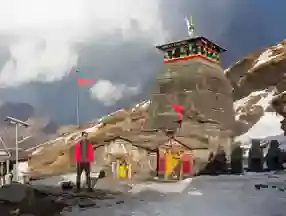
The Tungnath Chopta trek starts at the Chopta meadow base (2,680m) and ascends 1,000 metres over 3.5km to the temple. The trail is well-marked, stone-paved in sections, and generally easy to moderate for reasonably fit walkers. Allow 2–3 hours for ascent and 1.5–2 hours descent. If you plan to continue to Chandrashila Peak (an additional 1.5km, 450m gain), allocate 5–6 hours total for the full round trip.
Trek Route Breakdown
Parking area and tea stalls at Chopta. Trek begins here. Horse/mule rides available for elderly or children up to Tungnath for approximately ₹700–1,000 one way.
The first section passes through dense rhododendron and buransh (Rhododendron arboreum) forest. In May–June, the trail blazes red with rhododendron blooms. The gradient is gentle here — a pleasant warm-up for the steeper section ahead.
The trail breaks out of the tree line into open alpine meadow (bugyal). Views of Chaukhamba and Kedarnath peaks appear. The final stretch is rocky and steeper — pace yourself. At 3.5km, the Tungnath Temple complex comes into view.
The main shrine contains a Shivalinga representing the arms (bahu) of Lord Shiva. Several smaller shrines surround the main temple — dedicated to Parvati, Nandi, and other deities associated with the Panch Kedar legend. The temple priests offer puja from 6 AM to 7 PM.
Continue 1.5km above Tungnath to reach Chandrashila Peak (4,130m). This is the legendary spot where Lord Chandra (the moon god) meditated. The summit rewards with an unobstructed 360° panorama of Kedarnath (6,940m), Chaukhamba (7,138m), Nanda Devi (7,816m), Trishul (7,120m), and Bandarpunch on a clear day.
Best Time to Visit Tungnath Temple
Tungnath Temple is open from May to November each year. In winter (December to April), heavy snowfall renders the trail impassable and the deity is ceremonially transferred to Ukhimath Temple, 20km away, where it resides until May. The best times to visit are:
Temple freshly opened for the season. Rhododendrons in full bloom — the trail is spectacular. Good visibility before monsoon clouds gather. Moderate temperatures (5–15°C at temple). Busiest season — arrive early to beat crowds.
Post-monsoon clarity gives the clearest Himalayan views of the year. Skies washed clean, snow fresh on distant peaks. Fewer crowds than May–June. Temperatures 0–10°C at temple. One of the most rewarding times for Chandrashila photography.
Monsoon season. The trek trail becomes slippery and leeches appear on lower sections. Visibility poor, mountain views blocked by clouds. Risk of landslide on access road. Trek is technically open but not recommended for casual visitors.
First snowfall of the season arrives in November. The trail and temple are dusted with snow — an extraordinary sight. Temple closes around mid-to-late November. Very cold (−5 to 5°C) — carry full winter gear. Extraordinary for snow photography.
How to Reach Tungnath Temple
Tungnath Temple is reached by trekking 3.5km from Chopta base. The nearest road head is Chopta village (2,680m), from where the trek begins. Chopta itself is accessible by road from several major points:
Delhi → Haridwar → Rishikesh → Devprayag → Rudraprayag → Ukhimath → Chopta. Best done overnight — halt at Rishikesh or Devprayag. Our Chopta packages include this overnight journey.
Rishikesh → Devprayag → Rudraprayag → Ukhimath → Chopta. Entirely on NH-58 and state highway. Scenic drive through Garhwal valleys. Start by 5 AM to reach Chopta by noon and complete the Tungnath trek the same day.
Haridwar → Rishikesh → Devprayag → Rudraprayag → Ukhimath → Chopta. Same route as Rishikesh with 20km added. Private cab or our Chopta tour package recommended.
Fly to Jolly Grant Airport, Dehradun. Direct flights from Delhi (40 min), Mumbai, Bengaluru, Kolkata. Hire a private cab from the airport to Chopta — approximately 7–8 hours.
Nearest major railway stations are Haridwar (240km) and Rishikesh (220km). Multiple trains daily from Delhi. Book a private cab from Haridwar or Rishikesh to Chopta — 7 hours. GMOU buses also run to Ukhimath; share jeep from Ukhimath to Chopta.
Essential Tips for Visiting Tungnath Temple
- Start your trek by 7–8 AM — clouds and mist often roll in by midday, blocking views. Clear mornings give the best visibility of Himalayan peaks from Chandrashila.
- Acclimatize before trekking — if you're driving directly from the plains, spend the first night at Chopta (2,680m) before attempting the trek. Avoid rushing up on day one.
- Carry warm layers even in summer — temperature at Tungnath is 5–15°C in May–June, and wind chill at Chandrashila can be severe. Fleece jacket and windproof outer layer are essential.
- Wear proper trekking shoes — the upper section of the trail is rocky and uneven. Avoid sandals, sneakers, or slippers. Ankle-support trekking shoes recommended.
- Carry water and snacks — tea and Maggi stalls exist at Chopta and near the temple, but carrying your own water bottle is wise. Stay hydrated at altitude.
- No entry fee, but dress respectfully — Tungnath is an active pilgrimage temple. Remove footwear before entering the shrine. Dress modestly — avoid shorts or sleeveless clothing inside the temple.
- Do not litter on the trail — Tungnath and Chopta are in an ecologically sensitive zone. Carry your waste down. Plastic bags are banned in this area.
- Altitude sickness precaution — at 3,680m–4,130m, mild altitude sickness is possible. Symptoms: headache, nausea, fatigue. Descend immediately if symptoms worsen. Do not ignore signs of AMS.
Nearby Attractions Around Tungnath & Chopta
Chopta is perfectly positioned for combining Tungnath with several equally spectacular Uttarakhand experiences: